
Republican Socialism?

Republicans, especially Donald Trump, love to frame progressive Democrats as “socialists.” Although they never explain what they mean by socialism, they imply that Democrats want so much government involvement in the economy that America will no longer be a capitalist country. How accurate is this framing? As I’ll explain in a moment, not at all.
A few Democrats like Senator Bernie Sanders and Congresswoman Alexandria Ocasio-Cortez call themselves socialists but they aren’t. Why? They want government to reign in capitalism for the benefit of the working and middle classes, not get rid of it.
People like Sanders and AOC are really what Europeans call social democrats who favor regulation of the capitalist economy, a large welfare state, and inclusive democratic decision making. That’s not socialism! Sanders and AOC do themselves a great disservice by calling themselves democratic socialists rather than social democrats because it makes it easy for Republicans to frame them as socialists, something most voters dislike.
But here’s the truth. Ironically, although neither Republicans nor Democrats are socialists, the Republican “socialist” frame fits Republicans at least as well as it fits Democrats! How is this possible?
When it comes to capitalism despite Republicans’ alleged aversion to government involvement in the economy, they have supported spending billions of taxpayer dollars to buy minority ownership in several big corporations. Government ownership of the means of economic production is quintessential socialism. Table 1, based on data from The New York Times, shows that Uncle Sam invested nearly $10.3 billion in corporations during Trump’s second term.
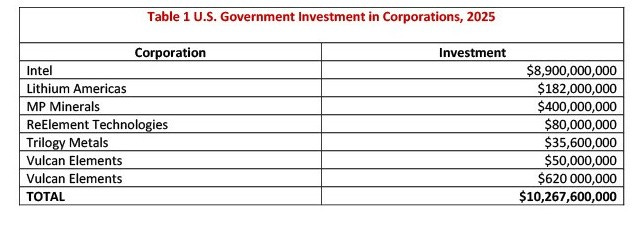
This does not include investments made by the government’s International Development Finance Corporation (DFC), which provides debt financing, equity investment, project development support, and political risk insurance for corporations doing business around the world. Trump established the DFC during his first term. Its website says that it has over $49 billion invested globally in dozens of companies and international funds.
According to Congress.gov, Trump has called for another $4.3 billion in DFC funding for 2026, including $3 billion in mandatory funding to expand DFC’s equity-based strategic investments—that is, more government ownership in private corporations. The Trump administration has also invested in corporations through the Departments of Defense, Energy, Commerce, and other agencies.
To be fair, Republicans as well as Democrats have long favored various forms of state investment in the economy. Sociologist Linda Weiss’s excellent book, America Inc., documents that since the Second World War the U.S. government under both Democratic and Republican administrations has pumped trillions of dollars into the economy through joint partnerships, subsidies, grants, cost-sharing agreements, and other programs with hundreds of corporations in dozens of industries. Often the money came from the Defense Department and related agencies for national security reasons.
This is called industrial policy, a form of state capitalism, something else Republicans disparage but have recently taken to a new level. According to The Seattle Times, “prior administrations have tried to speed the development of sectors like semiconductors and clean energy with grants, loans, tariffs and other policies. But taking equity stakes in companies is incredibly rare…The approach contradicts traditional Republican thinking about the power of the free market to identify winners and losers.”
Let’s be clear about one thing. Capitalism without government involvement is virtually impossible. Historians have shown that ever since the earliest days of capitalism the state has been involved in the economy in many ways. Even Adam Smith, one of Republicans’ favorite advocates of free market capitalism, acknowledged that the development of capitalism without certain forms of state intervention would be severely stunted. So, to equate socialism with government intervention, as Republicans often do, shows that they don’t understand how capitalism has always worked.
The point is twofold. First, there is nothing necessarily socialist about the government intervening in the economy. Second, ironically the socialist frame as conceived by Repubilcans fits them better than it fits the Democrats—especially on Trump’s watch. So, if Democrats want to fight fire with fire, maybe they should flip the script and frame Republicans as the socialists!
Thanks for reading this. Feel free to share it with others.
This ties in nicely with Michael Woodiwiss and Paul Klebnikov on US gangster capitalism and Putin-era kleptocracy. BTW, Democratic Socialists of America like AOC (and Rashids Taib and founder Michael Harrington) do seek an eventual transition from capitalism as private control of the means of production? Not sure where Sanders, not a DSA member, stands
If there were a functioning, non-partisan SEC they'd be taking a look at stock trades associated with that list of investments. Before Trump got involved with Intel, for example, the stock price was hovering around $20 per share. Now $40 per share. I don't believe that members of the Trump family and friends group haven't profited enormously off that trade.